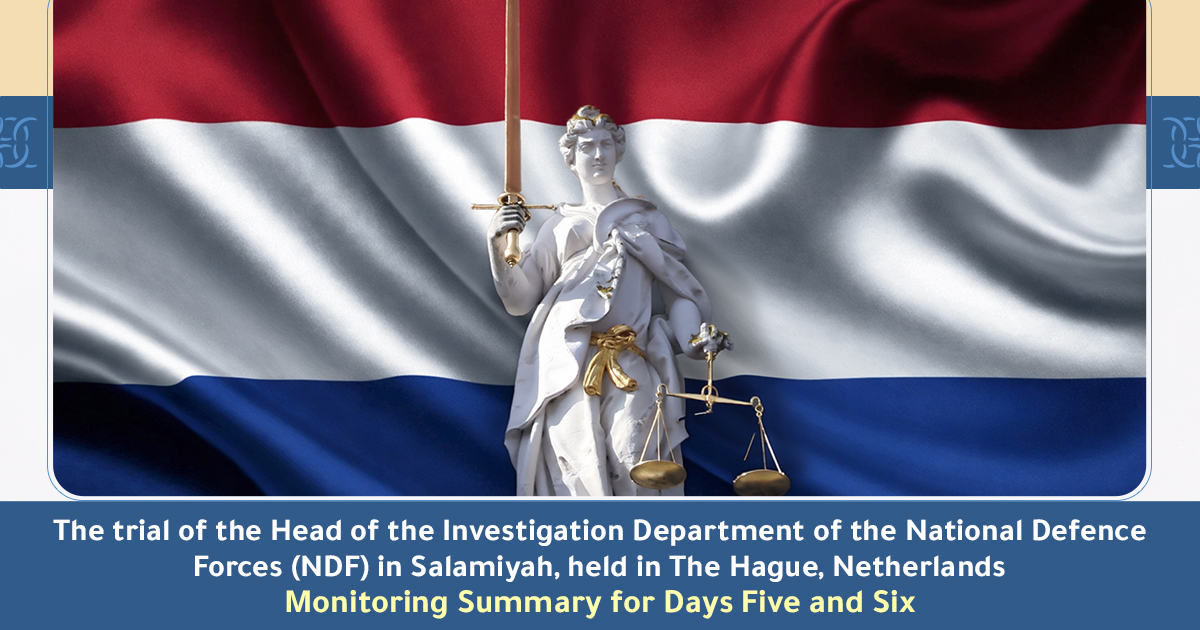
Hearing and the PP Final Statement on 21st and 22nd of April 2026
The hearing scheduled for 21 April began with a request from the accused to leave the courtroom, stating that he had nothing to do with the victims and did not wish to listen to the Public Prosecutor’s statement.
The prosecutor objected, noting that such a request demonstrated a lack of respect towards the victims, who were present in court and had followed the proceedings.
After briefly adjourning to deliberate, the Court rejected the request. While acknowledging that, in certain circumstances, a defendant may be allowed to leave, the judges found that no sufficient justification had been provided. They emphasised the importance of the accused remaining present, particularly in light of the victims’ participation.
Shortly thereafter, the hearing was interrupted due to technical issues with the livestream and could not proceed as planned.
The hearing on the 22nd was dedicated to the closing arguments of the Public Prosecutor, who presented both the contextual framework of the case and the evidence linking the accused to the alleged crimes.
The Shildon investigation began in November 2021, following information provided by a human rights lawyer, who shared witness statements indicating that a man residing in the Netherlands had been involved in serious international crimes in Syria. These statements described severe ill-treatment in detention centres in Salamiyah, where the accused allegedly worked as an interrogator and head of the interrogation department of the National Defence Forces (NDF) between 2013 and 2014.
Based on multiple, consistent witness accounts, the accused – who had previously been granted asylum in the Netherlands – was identified and subsequently arrested on 8 December 2023. The investigation evolved significantly after the fall of the Assad regime, as witnesses who had previously feared reprisals became more willing to testify openly.
The case now focuses on nine victims who have actively participated in the proceedings, including by attending hearings and submitting compensation claims.
The Public Prosecutor presented a detailed account of the broader context in which the alleged crimes took place, arguing that the case forms part of a widespread and systematic attack by the Syrian regime against the civilian population.
Relying on multiple authoritative sources, including the International, Impartial and Independent Mechanism (IIIM), the UN Commission of Inquiry on Syria, and relevant domestic and international case law, the Prosecution submitted that, from March 2011 onwards, peaceful protests across Syria were met with coordinated and escalating violence. This repression, directed at demonstrators, activists, and civilians alike, was organised at the highest political and military levels and aimed at suppressing dissent through fear and intimidation.
According to the Prosecution, torture and sexual violence were not incidental, but integral to this policy, used both to extract information and to punish and terrorise individuals and communities.
A central role in this system was played by pro-regime militias, which evolved into more structured entities, including the NDF, formally established in 2013. These groups operated under State authority, carrying out arrests, detention, and interrogations, and were granted significant powers, including control over detention facilities.
The case focuses on events in Salamiyah, described as a key location where protests were violently repressed and where civilians were arrested and subjected to ill-treatment. The Prosecution argued that the NDF actively participated in this repression, including through the operation of detention sites where torture and abuse occurred.
With regard to the accused, the Prosecution submitted that he held a significant role within the NDF as an interrogator, based on multiple consistent witness statements. These include both victim-witnesses, who described direct experiences of interrogation and abuse, and other witnesses familiar with the situation in Salamiyah, who identified him as part of the NDF structure.
Several witnesses described the accused as openly associated with the NDF, including through visible uniforms and weapons. Witnesses reported that his role as an interrogator was widely known within the community. Testimony from individuals such as A., H., and others indicates that information about interrogators was systematically collected and shared among opposition networks based on accounts from released detainees.
The Prosecution argued that the accused’s actions were directly linked to the broader State policy of repression, and that he acted with knowledge of the wider attack. His position within the NDF, combined with the scale and visibility of the violence across Syria, supports the conclusion that he was aware that his conduct formed part of a widespread and systematic attack against civilians.
The Prosecution also presented documentary evidence obtained after the fall of the Assad regime, including internal security reports, correspondence, and NDF records. While documents potentially obtained under coercion were not relied upon for the truth of any confessions or statements, the Prosecution argued that they remain relevant to establish roles, functions, hierarchy, arrest dates, transfers, operational orders, and organisational structures.
Several documents refer to the accused as an interrogator for the NDF in Salamiyah. One internal security study from 2015 advised against his return to judicial employment, stating that he had worked as an NDF interrogator and had been detained following allegations of sexual abuse of a female detainee. Another security study from 2019 similarly records that he appeared in the criminal register in connection with suspected attempted rape of women in his role as an interrogator in the NDF office.
The Prosecution also referred to a handwritten letter signed by the accused in September 2013, in which he referred to his work in the Information and Interrogation Department, as well as an NDF order summoning him for an interview. According to the Prosecution, these documents contradict the accused’s explanation that his involvement with the NDF was limited to clerical tasks.
The reliability of the documents was assessed by looking at their origin, formal characteristics, authentication process, and consistency with other evidence. The Prosecution noted that some documents were assessed by the Syria Justice and Accountability Centre (SJAC), which concluded that they were authentic. Their content was also consistent with witness statements concerning the accused’s role, his detention by the NDF, the reasons for that detention, and his later departure from Syria.
Taken together, the witness statements, documentary evidence, and other investigative findings support the conclusion, according to the Prosecution, that the accused worked for the NDF in Salamiyah as an interrogator from an early stage of the uprising and later held a position of real authority within NDF detention centres.
The Prosecution argued that the accused was not merely present during interrogations, but exercised control over detainees and over those working under him. Witnesses described him as the person deciding whether detainees would remain imprisoned or be released, directing the content of reports, giving orders during interrogations, and supervising or instructing others in the use of violence. Several witnesses also stated that he was addressed with titles indicating authority and respect.
The Prosecution then addressed the reliability of the witness statements. It stressed that caution is required, given the passage of time and the traumatic nature of the events described. However, it also noted that trauma does not automatically undermine reliability, particularly where the core elements of the testimony remain consistent and are supported by other evidence.
According to the Prosecution, the witness statements in this case were obtained in a careful and reliable manner by specialised investigators, with experienced interpreters and additional safeguards in place for interviews involving sexual violence. Allegations of improper influence by third parties, including the Syrian human rights lawyer or his organisation, were examined but no indications of improper influence were found.
The Prosecution then discussed the specific allegations concerning the different detention locations: the Carpet Factory, the Villa of the Kuwaiti, and Tal el Tut. Across these locations, the Prosecution identified a consistent pattern: detainees were held by the NDF, subjected to violent interrogations, torture, inhuman treatment, and sexual violence, and the accused was repeatedly identified as playing a central role in those interrogations.
With regard to the victims’ claims, nine victims submitted civil claims seeking compensation for the harm suffered. The Prosecution argued that these claims are directly linked to the criminal acts charged in the case and can be assessed within the criminal proceedings. It also addressed issues including applicable law, limitation periods, immunity, causation, statutory interest, and the fact that the accused may not be able to pay compensation himself.
Finally, the Prosecution addressed sentencing. It submitted that the case concerns extremely serious crimes committed against nine victims in NDF detention centres in Syria in 2013 and 2014. The Prosecution considered the charges proven, including nine counts of torture and inhuman treatment, six counts of sexual violence, and one count of rape.
The Prosecution emphasised the severe and long-lasting consequences for the victims, including psychological trauma, fear, loss of trust, social isolation, and ongoing physical effects. It also referred to the accused’s conduct during the proceedings, his attitude, and the danger he continues to pose to society.
Taking all circumstances into account, the Prosecution requested that the court find all charges proven, award the victims’ claims for damages, and impose the highest possible sentence: 30 years imprisonment, with pre-trial detention deducted.