Hearing on the 12th of May 2026
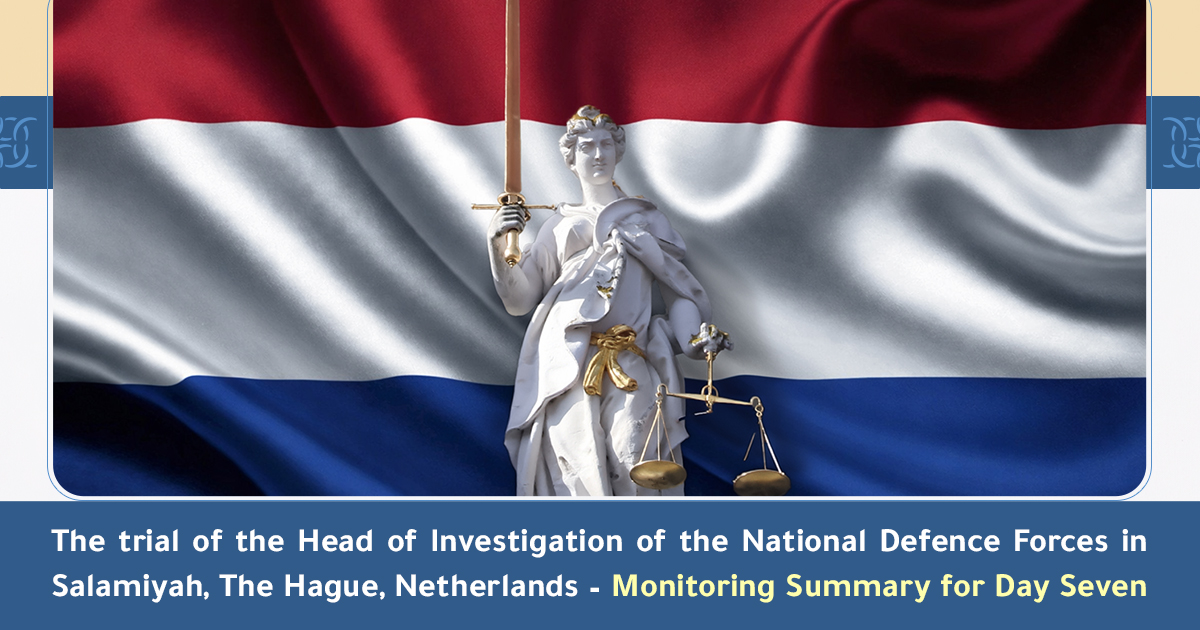
The hearing on 12 May was dedicated to rejoinders. The first response was made by the victim’s counsel, followed by the prosecution, the defence, and finally the defendant himself.
The victims’ counsel began by responding to the defence’s arguments on compensation, focusing on three main issues: access to Syrian law, immunity, and the statute of limitations. First, the defence argued that it lacked sufficient access to Syrian legal sources and that the three expert reports relied on older case law, which allegedly did not reflect the current state of Syrian jurisprudence. The victims’ counsel rejected this argument, stating that it is standard for case law to remain valid over time, including in Syrian, Dutch, and American legal practice. Counsel also emphasized that all parties had been given the same access to Syrian law and that the three expert reports provided sufficient information on the applicable legal framework. In addition, counsel stressed that the defence had multiple opportunities to respond to and ask questions about Syrian law, both in written submissions and during questioning.
The victims’ counsel then addressed the defence’s argument that the defendant would enjoy immunity under Syrian law as a public official. Counsel rejected this, arguing that such immunity is mainly relevant in criminal proceedings rather than civil compensation claims. Counsel argued that even if Syrian law were to grant the defendant immunity as a public official, the Dutch court should refuse to apply it; recognising immunity for torture would be contrary to Dutch public policy, since torture is considered an international crime under customary international law.
Counsel also responded to the defence’s argument that the claims would be barred under the Syrian statute of limitations. Counsel argued that, given the absence of a functioning rule of law in Syria, the victims could not realistically have brought their claims within the limitation period.
The victim’s counsel concluded by stressing that this is the only realistic opportunity for the victims to receive compensation for their suffering, and that this assessment does not constitute a disproportionate burden on these criminal proceedings.
The Prosecution then gave its rejoinder, responding to four main issues raised by the defence: the request to exclude the charges concerning R. and O., the classification of the alleged acts as sexual violence as a crime against humanity, the defence’s approach to the evidence, and the reliability of several witness statements.
First, the Prosecution addressed the defence’s argument that the charges concerning R. and O. should be excluded from the proceedings because the accused was allegedly tortured by the NDF. The Prosecution rejected this argument, stressing that the alleged mistreatment was not carried out by Dutch authorities and did not have a decisive influence on the Dutch investigation or the fairness of the trial. Therefore, the Prosecution argued that the defence’s request could not succeed.
Next, the Prosecution addressed the defence’s argument that the acts in the indictment do not amount to sexual violence as a crime against humanity. The defence argued that the accused did not have the required intent, and that the acts were committed for personal gratification rather than to harm the civilian population. The Prosecution rejected this. It argued that sexual violence was part of the NDF’s broader pattern of violence against civilians. It also stressed that an individual act does not need to have a political or military purpose on its own. Even if the accused acted for personal reasons, the acts could still form part of the wider attack against civilians.
The Prosecution also rejected the defence’s argument that some of the acts were not of comparable severity to the other crimes listed in the International Crimes Act. It argued that the acts must be assessed in context, including their psychological and humiliating impact.
The Prosecution then made a general point about the defence’s approach to the evidence. It argued that the defence was doing something that often occurs in criminal cases: taking individual pieces of evidence in isolation and making separate claims about each one. According to the Prosecution, this is not how judges assess evidence; instead, the evidence must be evaluated holistically and taken together.
The Prosecution then addressed several of these claims about insufficient evidence. They argued that differences in memory or detail do not automatically make a witness unreliable, especially given the passage of time, the trauma involved, and the taboo surrounding sexual violence in Syria.
The Prosecution also stressed that the core of the victims’ statements remained consistent. For example, in relation to O., the Prosecution argued that, even though O. may have differed on the exact moment or circumstances in which she recognized the accused’s voice, what mattered was that she consistently stated that she did recognize it as the same voice she had heard during her torture.
The Prosecution concluded by referring to a statement made by one of the victims, R., when exercising her right to speak in court:
“I never thought there would come a day where I could assert my rights in this way in the name of justice. I thought everything would stay there in Syria, and that he might some day be tried here. I continued to hope that justice would prevail through this court. For me, this is a very important opportunity to regain my rights and dignity.”
After a break for the defence to prepare its response, defence counsel addressed several issues, including the alleged torture of the accused, the classification of the alleged acts as sexual violence and torture, the reliability of the evidence, the victims’ compensation claims, and the Prosecution’s holistic approach to the case.
First, defence counsel maintained that the charges concerning R. and O. should be excluded from the proceedings because the accused was allegedly tortured by third parties in connection with the very conduct for which he is now being prosecuted. Defence counsel argued that, if serious torture of a suspect as a direct consequence of the alleged facts does not lead to consequences for the prosecution, it is difficult to see what would. In the defence’s view, the alleged mistreatment was closely linked to the charges concerning R. and O., and as such should be dismissed.
Second, defence counsel then addressed the Prosecution’s argument that the alleged sexual violence formed part of a widespread or systematic attack against civilians. The defence did not dispute that the NDF was generally responsible for violence, including sexual violence against women. However, it argued that there was insufficient evidence that such sexual violence was committed by the NDF in Salamiyah specifically. Defence counsel submitted that, if the allegations concerning R. and O. are proven, they should be seen as acts committed by the accused as a sole actor against the wishes of the NDF rather than part of their policy.
The defence also returned to the issue of O.’s voice recognition and argued that this evidence should be excluded. Defence counsel submitted that O.’s recognition of the accused’s voice was not as clear or independent as the Prosecution suggested. It pointed to her sister’s statement, which suggested that O. first asked whose voice it was, that her brother then confirmed it was the accused, and that her emotional reaction followed only after that. The defence argued that this raised doubts about whether the recognition came from O.’s own memory alone.
Defence counsel further argued that some of the alleged acts were not of comparable severity to the other crimes listed in the International Crimes Act. In response to the Prosecution’s argument about context and psychological harm, the defence submitted that acts involving forced nudity, humiliation, or physical violence accompanied by degrading comments did not meet the required level of seriousness.
The defence also addressed the required intent for torture. It argued that necessity or general violence is not enough to establish torture; the Prosecution still had to prove that the accused acted with one of the specific purposes required for torture, such as obtaining a confession, punishment, intimidation, or spreading fear. In the defence’s view, this specific intent had not been proven, particularly in relation to R. and O., where the defence argued that the alleged acts were motivated by personal sexual gratification rather than a prohibited purpose.
Defence counsel then responded to the victims’ compensation claims. It argued that the claims raise difficult and unresolved questions of Syrian law, especially on statute of limitation periods and whether a case brought abroad can interrupt those periods under Syrian law. The defence stressed that recent Syrian case law has not been accessible, while the victims’ counsel relied on older case law from the 1970s and 1980s. In the defence’s view, these uncertainties make the claims too complex to be dealt with within the criminal proceedings and would place a disproportionate burden on the case. The defence therefore argued that these claims are better suited for a Syrian civil court, especially now that circumstances in Syria have changed since the fall of the Assad regime.
Finally, the defence responded to the Prosecution’s argument that the evidence should be assessed holistically. Defence agreed with taking a holistic approach to examining evidence, but argued that such an approach cannot be used to include weak or contradictory evidence simply because it fits the Prosecution’s broader narrative. The defence stressed that each individual allegation must still be supported by sufficient evidence, and that circumstantial evidence should be treated with caution where the alleged incidents happened in very different ways.
The defendant then addressed the court personally. He began by speaking about the broader context of the Syrian conflict and Salamiyah’s position during the crisis. He presented himself as speaking not only for himself, but also as someone from Salamiyah, repeatedly referring to “we the people” and rejecting the way the city had been portrayed in the case file. He rejected the idea that Salamiyah had no functioning legal order, stating that courts, schools, and hospitals continued to operate, and that even a higher court of appeal was established there during the conflict, in an attempt to “defend the Syrian judge.”
The defendant also claimed that the case against him was shaped by media campaigns and rumours after his arrival in Europe. He described the intentions of those acting against him as “satanic” and said that false accusations had been spread about him and about Salamiyah. He also said that his trust in the court had been breached because photographs from the case file had made it to the public.
He then addressed specific pieces of evidence and witness statements, arguing that several descriptions of him were inaccurate. At one point, he asked whether he could move closer to the court to show the judges his physical appearance, including his hair, eyesight, and other features, which he said did not match descriptions given in the file. The court did not allow him to approach. He maintained that witnesses had wrongly described him and that some statements contained inconsistencies about locations, events, and the number of detainees.
The hearings will formally close on May 26 at 8:45 in the morning. According to the Court, no substantive matters will be discussed during that session, as it is intended only to formally close the proceedings. There will also be no livestream that day.
The judgment is scheduled for June 9th at 13:00.