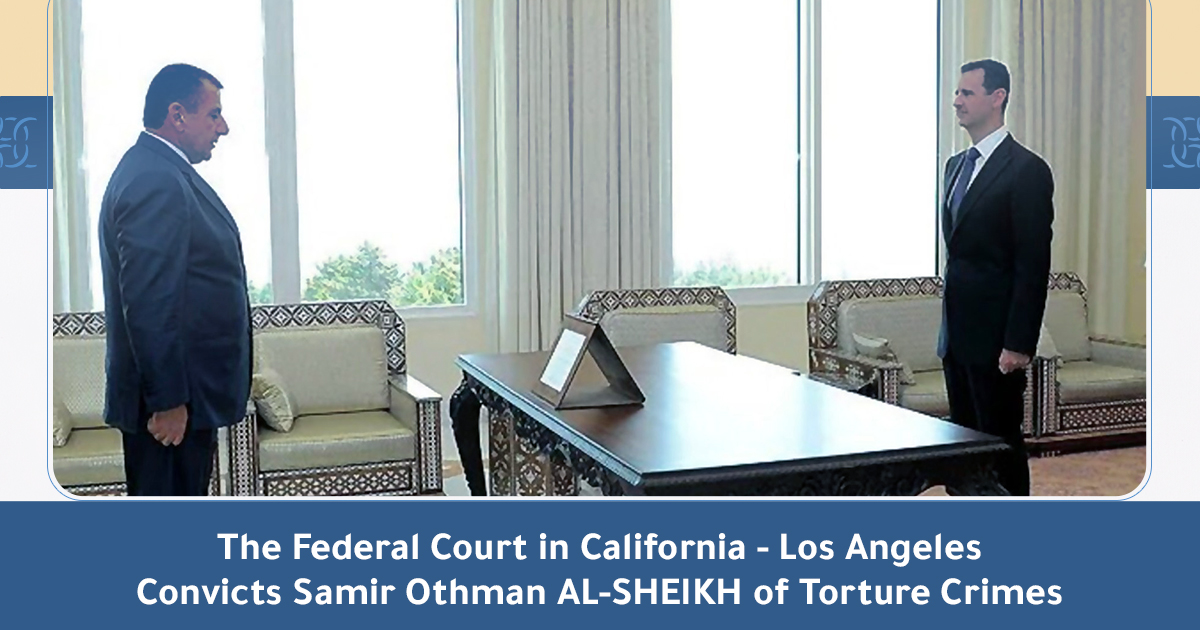
The Syrian Center for Media and Freedom of Expression (SCM) welcomes the conviction of former Syrian official Samir Othman AL-SHEIKH by a jury at the Federal Court in Los Angeles – California. AL-SHEIKH, who served as Governor and Head of the Security Committee in Deir ez-Zor from July 2011 to July 2012, and held the position of Director of Damascus Central Prison (Adra Prison) between 2005 and 2008, was convicted of committing torture crimes and serious violations against detainees.
SCM had responded in June 2023 to a request from the U.S. legal authorities to support the investigations they were conducting regarding the suspect. The Strategic Litigation Project team at SCM prepared a comprehensive file of evidence, which included testimonies from /9/ witnesses and /2/ investigative testimonies, confirming the suspect’s involvement in complicity in committing serious crimes during his tenure as head of the Security Committee in Deir ez-Zor. SCM documented a list including the names of /680/ victims who suffered violations of killing and detention during the period in which AL-SHEIKH was in office in Deir ez-Zor.
According to what was announced by the U.S. Department of Justice, AL-SHEIKH was convicted of conspiracy to commit torture, in addition to three separate counts related to acts of torture within detention centers, alongside his conviction for crimes related to fraud against U.S. immigration authorities to obtain permanent residency and attempt to acquire citizenship.
The investigations conducted by SCM indicated violations committed by the Security and Military Committee in Deir ez-Zor during the period of Samir Al-Sheikh as Governor:
- Declaration of violent confrontation: He publicly stated that he had received a green light from President Bashar AL-ASSAD to suppress the popular movement with an iron fist.
- Responsibility for violations: He cooperated with Brigadier General Jameh Jameh in carrying out arbitrary arrests and torture against civilians participating in the popular movement.
- Military intervention: He supported the Security Committee’s request for military intervention to suppress protests violently in August 2011.
- Torture and detention: He was aware of torture practices and interrogations at the Anti-Narcotics branch, where detainees were subjected to severe torture methods.
- Security center in his home: He used his home as a center for mobilizing security forces to suppress demonstrators and detain civilians.
- Targeting protesters: Under his directives, security forces attacked and opened fire on peaceful demonstrators, resulting in numerous casualties.
- Inhumane detention conditions: Detainees at the Security Committee headquarters were subjected to degrading conditions and mistreatment, including electric shocks and severe beatings.
- Concealment of shelling violations: He attempted to cover up the shelling of Othman Mosque and portray it as undamaged.
- Manipulation through promises: He promised detainees arrested in connection with protests that they would be released in exchange for chanting in support of the President.
This conviction represents a pivotal milestone in the pursuit of justice and accountability, and confirms that the prosecution of perpetrators of international crimes can be achieved through the principles of universal jurisdiction, international human rights law, and international humanitarian law.
Furthermore, this case serves as a clear message that impunity will not prevail. It demonstrates that justice—no matter how delayed—remains achievable through the struggle of victims and survivors, the persistent efforts of civil society organizations, and the independence of judicial systems.
In this context, SCM emphasizes the following:
- This conviction represents an important precedent in the prosecution of international crimes committed against Syrians in the United States of America.
- The necessity of expanding the use of universal jurisdiction to hold those responsible for international crimes accountable, including crimes against humanity and war crimes.
- The importance of ensuring the protection of victims, survivors, and witnesses, and guaranteeing their access to comprehensive justice, including reparations.
- The continued need to support professional and independent documentation efforts, given their crucial role in the success of judicial processes.
While AL-SHEIKH faces penalties that may reach up to 20 years of imprisonment for each of the torture-related charges, in addition to 10 years for the fraud charge related to immigration and nationality, this underscores the seriousness of judicial prosecutions and the possibility of achieving tangible accountability. It is important to note that the case is currently in the pre-sentencing phase.
The Syrian Center for Media and Freedom of Expression (SCM) renews its commitment to continue working alongside victims/survivors and to advancing paths toward justice and accountability, in a manner that ensures the non-repetition of such crimes and achieves genuine and sustainable redress.