By Simav Hesen, Ranim Ghassan Khalouf
In a corner of his house in Salqin, a city in Syria’s northwestern Idlib province, agricultural engineer Abdullatif Boubki stacks metal tins filled with olive oil: his land’s harvest from last season.
Up until 2012, Boubki relied on olive oil as a source of income. But when the conflict intensified in the Idlib countryside that year, the road was cut off. No longer able to sell his oil, he made a habit of storing it at home.
Olive oil is a strategic commodity that does not lose its value, but worry never leaves Boubki. Water—not olives or oil—is his daily concern. He spends hours browsing local Facebook pages and Telegram channels, searching for updates on water availability through the public network in his neighborhood, to know whether he will have to buy a water tanker.
Boubki’s story is a microcosm of the broader situation in Syria, which has topped the Global Conflict Risk Index since 2022 as the most drought-prone country in the Mediterranean. But even as the country suffers an acute water crisis, thousands of cubic meters of groundwater are flowing into the global market in the form of olive oil, an export that represents both national pride and a silent depletion of resources.

The Standard Differential Vegetation Index (SDI) measures green vegetation cover. It is a measure of vegetation health based on how plants reflect light at specific wavelengths. The map shows high vegetation activity in irrigated and river basins between August 1 and November 11, 2025, reflecting the varying availability of agricultural water across different areas. (Copernicus Maps)
The Ministry of Agriculture anticipates an average to low olive season in 2026: at most 412,000 tons of olives yielding an estimated 65,000 tons of oil. At the level of domestic Syrian consumption alone, this amount is less than the annual average of an estimated 2.6 kilograms per person, according to the International Olive Council.
This investigation examines the water loss associated with olive oil exports from Syria, exploring how oil has become an undeclared carrier of water out of the country, even as towns and villages struggle to secure their daily needs for drinking and agricultural water.
This investigation relies on the concept of “virtual exported water,” which refers to the amount of water used to produce goods exported outside a country’s borders, to highlight the relationship between agricultural trade and water security. It seeks to address the question: How can economic activity contribute to the depletion of national water resources?
Olive production in Syria from 2013 to 2022, according to data obtained from the Syrian Source Encyclopedia.
Syrian olive oil production, consumption and exports between 1990 and 2024, according to the International Olive Council.
Several Syrian provinces are renowned for olive cultivation and oil production, including Idlib, Aleppo, Tartous, Latakia, Hama, Daraa and Reef Dimashq. In Idlib alone, the average annual production is estimated at more than 100,000 tons of olives. Aleppo’s northwestern Afrin region is famed for its olive oil, while coastal Tartous and Latakia are known for their rain-fed olives. However, declining rainfall and the proliferation of illegal shallow well drilling in recent years have led these areas to face an increasing risk of drought.

The Normalized Difference Moisture Index (NDMI), used to determine vegetation water content and monitor drought, between August 1 and November 11, 2025. Blue sections show high vegetation moisture, mainly concentrated in irrigated agricultural areas and along rivers, while the orange and red show a significant decrease in moisture in arid and desert regions, suggesting water stress. (Copernicus Maps)
Open-source data from the World Resources Institute’s Aqueduct platform indicate that water stress in both Aleppo and Idlib is very high, exceeding 4.6 on a scale ranging from low to very high (1-5). In Latakia and Tartous, it is very high, reaching 3.9. The rate of water scarcity and depletion is very high in all four provinces, exceeding 4.15, which means that water sources are being consumed faster than they are replenished.
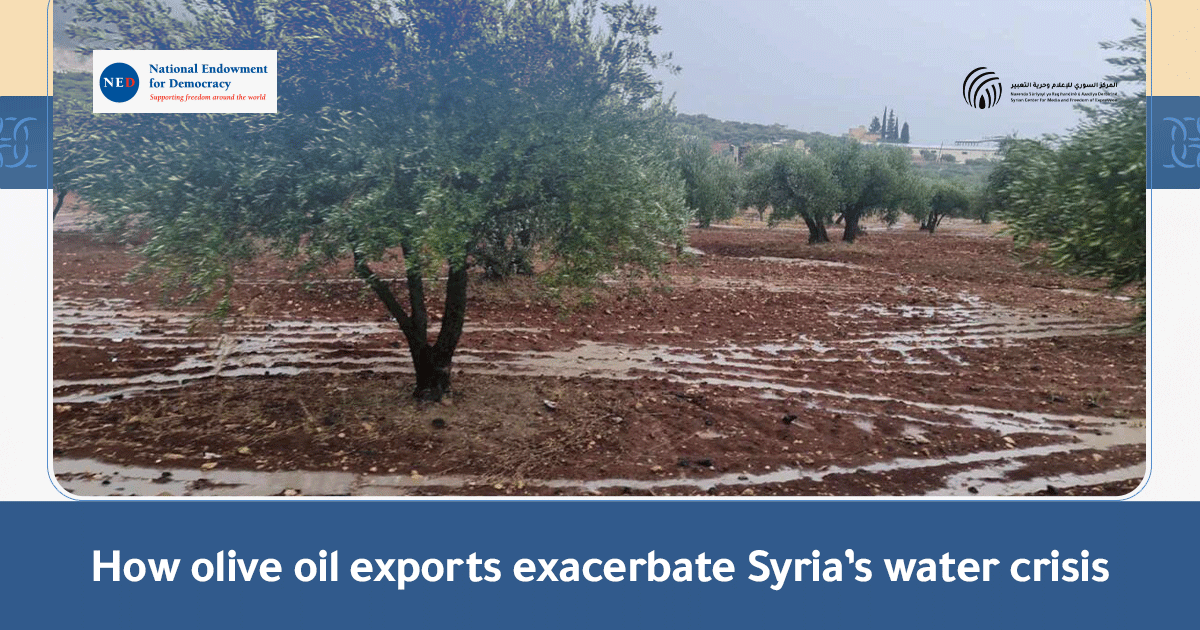
Years ago, Boubki successfully revitalized his ancestral land in Salqin by equipping half of its area with a modern irrigation system. His trees’ yield was economically satisfactory, but the irrigation project was destroyed when the well that irrigated 15 dunams (approximately 15,000 square meters) dried up. The reason, according to Boubki, was “the haphazard proliferation of wells in the region,” which led to the depletion of the groundwater reserves at an unprecedented rate.
The trees on Boubki’s land have become part of a sensitive water equation, as surrounding lands rely on well water to compensate for continuously declining rainfall levels. Annual rainfall in Syria fell to 291.59 millimeters in 2024, down from 299.42 millimeters in 2023, representing a decrease of more than 100 millimeters compared to 2017.

source: tradingeconomics.com
Average Rainfall in Syria between 2013 and 2024 Trading Economics
By the numbers: Oil’s water requirements
A March 2024 report by the Water Footprint Network, indicates that Syrian agriculture is the primary source of water consumption in the country, accounting for more than 80 percent of available water resources.
Most Syrian crops—primarily olives and wheat—rely on green water (rainwater). However, declining rainfall and the expansion of irrigated areas in recent years have increased reliance on blue water (extracted from surface and groundwater wells), thus intensifying the pressure on the national water reserves.
The Water Footprint Network report also clarifies that Syria is among the countries that export virtual water through its agricultural trade, particularly through water-intensive products such as olive oil. Beyond its economic value, every ton of this oil represents thousands of cubic meters of water consumed in cultivation, pressing and transportation, which effectively leaves the country upon export.
This pattern of “invisible water leakage” exacerbates water insecurity in the absence of clear water resource management policies and the alignment of agricultural production with limited water resources.

The Normalized Difference Wetness Index (NDWI), used to map water bodies, between August 1 and November 11, 2025. Water body values are greater than 0.5, while vegetation cover values are lower. Constructed features range from 0 to 0.2. The map indicates a decrease in surface moisture across most agricultural lands, meaning olive production will rely heavily on irrigation, thereby increasing water use associated with olive oil production. (Copernicus Maps)
“Water footprint” refers to the total amount of water used to produce a good or service through its various stages, whether this water is extracted from rainfall (green water), from surface and groundwater sources such as rivers and wells (blue water), or the water required to treat pollutants resulting from production (olive mill wastewater).
In olive production, the water used is not limited to irrigation, but also includes water that is necessary later to mitigate pollution from fertilizer or pesticide residues that may seep into the soil and groundwater. This additional water is counted with olive mill wastewater, and is a key component of the crop’s water footprint.
“Virtual exported water” refers to the amount of water used to produce goods sold outside a country’s borders. For example, when Syria exports thousands of tons of olive oil, it is not only exporting the oil itself, but also the enormous quantities of water consumed in olive cultivation and oil extraction. This concept highlights the relationship between agricultural trade and water security, revealing how economic activity can unintentionally contribute to the depletion of national water resources.

Despite the scarcity of statistical sources on the water footprint of various crops in the Middle East and the limited research and studies measuring this footprint in the region, available sources indicate that producing one ton (1,000 kg) of olives requires approximately 5,000 cubic meters of water. That is, each kilogram of olives requires 5,000 liters of water.
Producing one liter of oil requires four-to-six kilograms of olives, meaning that each liter of olive oil requires approximately 20,000 liters of water.
These figures illustrate the plight of Saadallah Hamida, who has owned an olive press in Salqin since 1996. The well that supplies the olive pressing water is as old as the press itself, but it now only provides enough water for four hours of pressing, forcing him to buy most of the remaining water from tankers.
“The press needs about eight cubic meters of water per hour during the olive harvest season. Due to the reduced water flow from the well, I have to pay 800 Turkish lira for each eight-cubic-meter tanker for every hour of operation during the harvest season,” Hamida explained.
Olive mill wastewater
While the figures for olive oil water consumption seem plausible, there are no clear indicators to help calculate the amount of greywater produced by the olive press, nor are there any effective policies for its proper disposal.
Olive mill wastewater (OMW) poses a significant environmental risk when disposed of without treatment. These wastes contain dense organic matter and have a high chemical oxygen demand, in addition to high acidity and toxic phenolic compounds. This leads to soil, surface water, and groundwater contamination, harming plants and beneficial microorganisms in the agricultural environment.
Storing this water in open ponds or basins causes the emission of polluting gases such as methane and hydrogen sulfide, along with a strong and unpleasant odor that affects air quality and surrounding areas. In addition, neglecting to treat this water hinders its recycling within a sustainable water cycle, leading to the waste of water resources, which is extremely dangerous in water-scarce regions.
Boubki says that having a treatment plant plan, supervised by an environmental engineer, is a licensing requirement for olive presses or any other facility that might produce pollutants. However, the treatment plant plan “remains shelved.” While all licensed presses have submitted treatment plans, “no one complies, except for a few, and the presses often dispose of their waste through sewage systems or nearby rivers,” a fact documented by the reporter during a field visit to the city of Salqin.

A report issued by the Japan International Cooperation Agency (JICA) on development in the sanitation sector confirms that liquid waste from olive presses constitutes a major source of groundwater pollution in some Syrian regions.
The problem of indiscriminate olive waste disposal extends to all olive-growing areas, and becomes particularly apparent during the harvest season. Press reports have documented the suffering of residents in coastal Tartous province during the olive harvest season due to some presses disregarding regulations concerning safe waste disposal.
Oil profits, water losses
Al Reef Company, one of Syria’s olive oil exporters, said in a statement that it cannot predict the quantity of exports in 2026, but that it exported 500 tons last year, primarily to Gulf countries.
The company relies on presses in various regions of Syria, it said, including Aleppo, the Syrian coast and Homs, and bases its oil pricing on the price at which it buys from the presses. Last year, this did not exceed six dollars per liter, while this year it is expected to reach more than eight dollars.
Syria’s Ministry of Agriculture did not respond regarding the government’s export strategies and plans for 2026, nor did it provide any figures on the expected harvest. However, the Saudi channel Al-Hadath TV quoted Abeer Jawhar, Director of the Olive Bureau at the Ministry of Agriculture, as saying: “The olive production in Syria this year is expected to reach about 412,000 tons, and only 65,000 tons are expected to be extracted as olive oil, which is considered an average-to-weak season.”
The decline in production is partly attributed to the phenomenon of “alternate bearing,” the fluctuating production from one year to the next, as well as “technical and structural problems in farm management and the fragmentation of agricultural landholdings, which led to the death of a large number of trees and a decline in olive production,” Jawhar said.
Hala al-Hamid, a water and environment specialist, said water-scarce countries must reconsider their export policies so that their assessment of exported products is not limited to economic value but also takes into account water value and water loss.
While foreign markets boast about bottles of Syrian olive oil, thousands of cubic meters of water leave with them—water that could have irrigated parched villages or revived orchards whose roots are withering day by day. Between olive presses struggling to find water to operate their machinery, farmers watching their wells dry up, and a government lacking clear resource management policies, agricultural trade is transforming from an economic opportunity into an additional factor exacerbating water loss.
This investigation was prepared by two journalists as part of a project implemented by the Syrian Center for Media and Freedom of Expression (SCM), with support from the National Endowment for Democracy (NED). The views expressed are solely those of the authors.
The investigation was published on the Syria Direct website on 26 February 2026.